Why Did Our Lvies Intersect Again
SEOUL —
Not long later nightfall on New year's Day, a curt, slight man picked a spot along ane of the almost heavily fortified borders in the world, a quarter-mile from the nearest platoon of soldiers, and scaled a 10-foot-tall wire fence.
Warning lights flashed and an warning blared. The human being hurried over rough terrain dusted with snow, navigating the threat of untold country mines left over from a concluding-century war, his movements slipping in and out of view of thermal cameras.
By midnight, he'd made information technology across the 2.five-mile demilitarized zone. He was back home — in North Korea.
Hours later, S Korean soldiers, who discounted the evening's disturbance as a fake alarm, would realize they'd missed the man'southward footprints and the wisps of down feathers from his wintertime jacket clinging to the concertina wire atop the border fence.
More than 33,000 North Koreans have risked their lives to flee their oppressive homeland in recent decades, leaving behind an impoverished economic system, fearfulness bred by political gulags and a third-generation cult of personality that demands unquestioning reverence of leader Kim Jong United nations and his forebears. The New year's day's fence-jumper, who has non been publicly identified, became one of a much smaller number to make their mode dorsum to the isolated communist state afterward a taste of the outside globe.
Officially, near xxx North Koreans are known to have returned after settling in the Southward, according to South Korean intelligence. Researchers and advocates approximate that the real number is likely much higher, possibly in the hundreds. Some of those who render go propaganda tools for the North Korean state, actualization in videos or news conferences making tearful statements nearly how much they regretted leaving. A handful change their minds still once more, escaping once more.
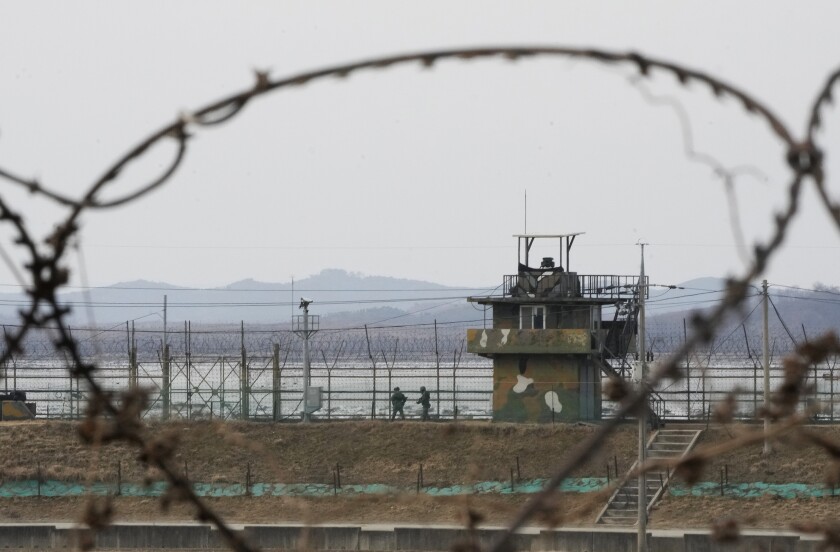
Wire fences line the demilitarized zone betwixt North and Southward Korea, one of the near heavily fortified borders in the world.
(Ahn Immature-joon / Associated Press)
"Information technology's hard to approximate, simply information technology's probably many more," said Baek Nam-seol, a professor at the Korean National Police University who has worked with and researched North Korean refugees. "In that location are surely ones who aren't picked upwardly past N Korean government. We but get confirmation when North Korea chooses to publicize it."
The man'southward crossing spurred a frenzy in South korea over the breaches in border security, peculiarly after the revelation that the human being had crossed into South Korea in November 2020 forth the same road, twice evading detection by Due south Korean military. Amidst those working with or researching North Koreans' resettlement in the Due south, though, his decision to return after barely a year marked the latest testament to the challenges North Korean refugees confront adjusting to their new home, their isolation and economical difficulties furthered past the pandemic.
Nearly 1 in 5 Northward Korean refugees in Republic of korea said they have idea about going dorsum, according to a 2021 survey past the nonprofit Database Center for North Korean Human Rights. The reason most often given is missing one'due south hometown or family. Some said they experienced discrimination in Republic of korea or constitute the capitalist society too competitive, co-ordinate to the survey.
Joo Seong-ha, who left N Korea in 2002 and works every bit a prominent journalist at a South Korean newspaper, said he still finds himself thinking of home.
"I've idea almost it. If you lot take family there how tin can yous not?" he said. Fifty-fifty then, most refugees put downward roots afterwards a few years and make their way in an adopted country. "Every customs has its outliers, and the North Korean refugee community is the aforementioned. It's only that this outlier's style of acting out happened to be crossing the DMZ."
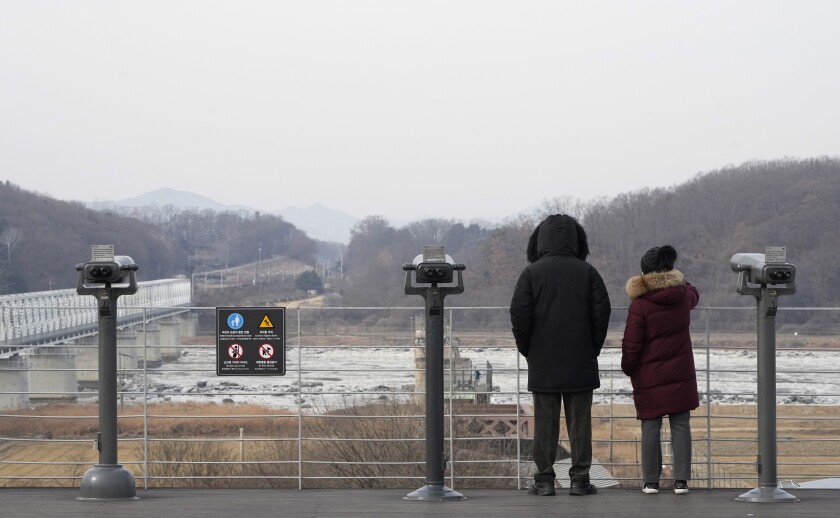
Observers expect toward Democratic people's republic of korea from an observation deck on the border in Paju, South Korea.
(Ahn Immature-joon / Associated Press)
Park Young-ja, a enquiry fellow at the South Korean regime-funded think tank Korea Constitute for National Unification, said those who don't have family members in the Due south accept a harder time adjusting. Their continuing challenges — even as tens of thousands of Due north Koreans have been living in South Korea for decades, appearing on television, running for part and starting businesses — suggest how much further South Korean society has to go toward embracing them, she said.
"It does show the limits to the potential for integration between Northward and Southward Koreans," Park said. "At the cease of the day, what'south needed is integration of the center."
Fifty-fifty though the Koreas share a common language, food and culture, in the 7 decades since the Korean State of war, lives on either side of the border take increasingly diverged every bit the Due south grew wealthier and North Korea more isolated. On pinnacle of international economic sanctions for Kim's nuclear and military ambitions, North Korea has imposed severe COVID-19 restrictions, furthering control of people and information in and out of the state.
After a brief thaw in relations in 2018, during which Kim met South Korea's president and both sides dismantled some guard posts in the demilitarized zone every bit a sign of goodwill, Kim has rejected entreaties and offers of help from the South Korean government.
Kim'south male parent, Kim Jong Il, who ruled for 17 years, had trivial regard for refugees, seeing them as traitors. But non long after his son took over in 2011, Democratic people's republic of korea began a concerted effort to lure escapees to return, offer them amnesty and a comfortable life in exchange for data about other N Korean refugees in South Korea, according to researchers.
"Under Kim Jong Un, they saw the refugees in Republic of korea as a threat to his hereditary rule," said Kim Yun-young, an adjunct professor at Cheongju University and former researcher at the Police Scientific discipline Institute. "At that place was much more of an effort for conciliation and enticement, sometimes using their remaining families as hostages."
In one 2016 video posted by a North Korean government-affiliated website, a 40-year-onetime homo who returned out of business organisation for the married woman he left behind said he faced discrimination and economic strife trying to make it in Republic of korea.
"I spent only a year and half-dozen months in S Korea, but every moment at that place felt like a decade, and every mean solar day was like hell," Kang Chul-woo, dressed in a dark Mao arrange with a pin of Kim Jong Un's father and grandpa'due south face affixed near his heart, said in the video. "I was treated with antipathy and disdain wherever I went considering I was a North Korean refugee."
That man again escaped North Korea eight months later, co-ordinate to South Korean court records. He was sentenced to three years and half dozen months in prison for providing North Korean authorities with information almost fellow refugees.
Other court cases involving Due north Koreans' attempts to return reveal a desperation that pushes escapees to get back. One man who worked in construction as a day laborer was defrauded of nearly $l,000 and was chased by debt collectors. Another had the deposit to his home seized when he couldn't pay back about $800 he owed the broker who had facilitated his initial escape. Another in his 60s had suffered a stroke and wanted to see his married woman and son once more before his death, and begrudged being treated like a migrant worker in Republic of korea, according to courtroom records.

Across the heavily guarded border, North Korea's Kaepoong town is seen from the observatory of the Aegibong Peace Ecopark in Gimpo, South korea.
(Lee Jin-homo / Associated Press)
Some prepared lump sums of cash to pay "loyalty fees" to North Korea's ruling Workers' Party to be absolved of having escaped the country, which is normally punished equally a criminal criminal offense with time in a prison campsite or forced labor, according to the records.
The New Year's jumper, who was almost 30 and reportedly told investigators he'd been a gymnast in North Korea, worked equally a janitor and struggled to make ends meet, according to local media reports.
The economic plight North Korean refugees can face was highlighted in 2019 when Han Sung-ok, a single mother, and her 6-yr-sometime son were found dead in their Seoul apartment, perchance of starvation. The mother and son'southward deaths became a rallying cry for beau refugees. South korea provides initial resettlement funds and housing for the outset five years, just many are left with nothing once they've paid broker'due south fees, and struggle to notice stable jobs.
Jeon Su-mi, an chaser who works equally an advocate for North Korean refugees, said many feel disillusioned past the individualism and capitalism of the Due south. The choice of refugees to voluntarily render should be an opportunity for reflection in South korea, she said.
"How set up was South korea to genuinely welcome and have these refugees in our midst?" Jeon said. "They risked their lives to get here and then adventure their lives once once again to exit. That should be a sign."
Source: https://www.latimes.com/world-nation/story/2022-01-09/some-escapees-pay-bribes-cross-rivers-risk-lives-to-return-to-kim-jong-uns-north-korea
0 Response to "Why Did Our Lvies Intersect Again"
Post a Comment