CalSTRS reports a big year of earnings
This graph, which does not include the latest rate of return on investment or scheduled increases in contributions rates, shows the volatility in CalSTRS' earnings over the past decade. Benefits payments increased while contributions from employers and employees declined, reflecting staffing cuts during the recession.
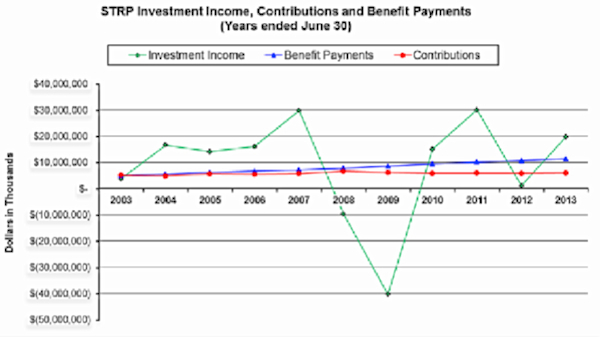
This graph, which does not include the latest rate of return on investment or scheduled increases in contributions rates, shows the volatility in CalSTRS' earnings over the past decade. Benefits payments increased while contributions from employers and employees declined, reflecting staffing cuts during the recession.
Riding the wave of tape high stock prices on Wall Street, the fund providing pension benefits for California teachers and school administrators reported Monday that information technology earned a render of 18.66 percent on its assets for the year that concluded June 30.
That'south nearly two½ times the 7.v pct return that actuaries say the California State Teachers' Retirement System must receive annually to fully pay for retirees' benefits. But even these "extraordinary and very encouraging" numbers don't undo the need for the big increase in contribution rates past teachers, schoolhouse districts and the state that legislators approved last month, a CalSTRS spokeswoman said.
CalSTRS has had a lot of ground to brand up. During the recession, between June 30, 2007 and June 30, 2009, CalSTRS lost $54 billion, about thirty percentage of its assets. Although the pension fund is now valued at $189 billion as of two weeks ago – $17 billion above the previous stop-of-year-high in 2007 – it lost billions of dollars in compounded returns over five years.
"A good yr is non enough to business relationship for the loss over time," said CalSTRS spokeswoman Gretchen Zeagler.
CalSTRS' defined benefit pension programme is funded by a combination of earnings on its portfolio of stocks and real estate and contributions by employees and employers (school districts), with the state paying into it as well. In a study 2 years ago, CalSTRS actuaries said that, in the wake of the recession, it would take "v consecutive years of over 17 per centum annual returns, followed by 25 years of meeting the assumed investment render of 7.5 percent annually to become fully funded in 30 years." That's too the equivalent of x per centum returns every year for 30 years – which assumes no economic recession or downturn on Wall Street in between.
Based on these calculations, Gov. Jerry Brown proposed nearly doubling almanac contributions. The Legislature canonical that increase in June. When fully phased in over seven years, schoolhouse districts would absorb 70 percent of the roughly $v billion almanac increase in contributions, with the state and employees picking up the rest.
The latest return marks the 2nd straight year of double-digit returns; it follows a 13.viii percent return in the year ending June 30, 2013. But the render the year before that was just 1.eight percent for a three-year rate of return of 11.ii percent. Its longer term functioning was adjusted upwardly as well:
- 5-year earnings: 13.7 percentage;
- 10-twelvemonth earnings: 7.7 percent (virtually what actuaries say it should be);
- 20-year earnings: eight.4 percentage.
With 860,000 members, CalSTRS is the nation's second-largest public alimony programme. The largest, the California Public Employees' Retirement Arrangement, or CalPERS, reported similar earnings on Mon: an increment of 18.4 percent for the yr ending June 30.
To go more than reports similar this one, click here to sign up for EdSource's no-price daily email on latest developments in education.
Source: https://edsource.org/2014/calstrs-reports-big-year-of-earnings/65421
0 Response to "CalSTRS reports a big year of earnings"
Post a Comment